Overcoming Imposter Syndrome and Finding Your Place in the Digital Arcane Arts as a inter or junior software developer.
“Any sufficiently advanced technology is indistinguishable from magic” – Arthur C. Clarke
During interviews, I used to ask, “What does Software Development mean to you?”.

Flying While Building is a reader-supported publication. To receive new posts and support my work, consider becoming a free or paid subscriber.
My thinking at the time was, a good candidate would have known themselves, and what drives them to excel in this field that crosses science, engineering, and philosophy.
Software Development is a very opinionated field, with people filled with experience, jargon, explanations for why a for-loop is better than a recursive function, or vice-versa. Why you should use object-oriented language paradigms over functional programming? Why strongly typed languages are superior to weak types? Why you should do E2E testing, or why Test Driven Development is the only way to do software development.
In such an infinitely deep field, I figured great software developers would have an opinion of what software development meant to them.
But I never got anything but blank stares.
Except one time.
One time, a new intern to the field, responded with:
“Software Development is like Magic”
Magic.
I really had never thought of it like that before.
“an extraordinary power or influence seemingly from a supernatural source” – Merriam-Webster Dictionary
or
“the use of means (such as charms or spells) believed to have supernatural power over natural forces”
Software Development is Magic.
This is an important thing for a Software Developer to know when interfacing with users, business stakeholders, new developers and generally anyone who is not a software developer. In their minds, building software is akin to the arcane arts. And if you think about it just a little, to someone with no idea how programming works (and to some degree to those who do), yes, this is mag

To a non-technical, this is what it looks like.
The Apprentice’s Burden: Imposter Syndrome in the Magic Circle
Here’s something they don’t tell you when you’re learning software development: everyone feels like an imposter. Everyone.
That senior developer who seems to know every design pattern? They’re googling basic syntax errors. That architect who designed the system everyone admires? They wake up in cold sweats wondering if they’ve made a terrible mistake. The CTO who speaks confidently about technology strategy? They’re constantly afraid someone will discover they don’t know what they’re talking about.
This feeling – this persistent fear that you’re a fraud about to be exposed – has a name: imposter syndrome. And in software development, it’s practically an occupational hazard.
Why? Because software development truly is like magic, and learning magic is hard. You’re expected to:
- Master arcane languages with mysterious rules and exceptions
- Remember countless incantations (APIs, libraries, frameworks)
- Understand complex systems built by hundreds of other wizards
- Create solutions that seem impossible to non-practitioners
- Keep learning new spells as the old ones become obsolete
No wonder 58% of tech workers report experiencing imposter syndrome. For newcomers, this feeling can be overwhelming. You look at experienced developers conjuring solutions with a few keystrokes, and it seems like they possess powers you’ll never attain.

We all feel this as developers.
The Secret All Master Wizards Know
Let me share something I’ve learned after a decade of building software systems: the magic never fully makes sense to anyone. Not completely. Not all at once.
The difference between experienced developers and beginners isn’t that the experts understand everything – it’s that they’ve become comfortable with not understanding everything.
They’ve learned to:
- Break down complex problems into manageable pieces
- Know where to find answers (not memorize every answer)
- Build mental models that help them navigate uncertainty
- Recognize patterns they’ve seen before
- Ask good questions when they’re stuck
The journey from apprentice to master isn’t about eliminating confusion – it’s about getting better at dealing with confusion.
<An image of a progression: a beginner developer looking confused at basic code, then a mid-level developer tackling more complex code with some confidence, and finally a senior developer comfortably navigating very complex systems while still having some question marks – illustrating that confusion never disappears, just gets managed better
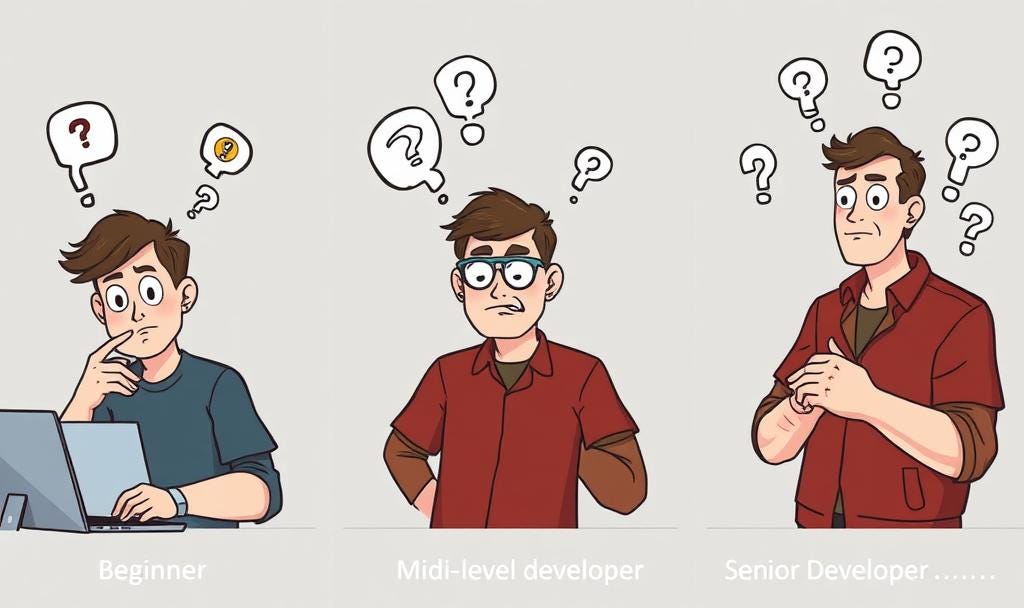
The questions just keep piling up
Signs You’re Growing as a Developer (Even When You Don’t Feel Like It)
If you’re new to development, here are some signs you’re making progress, even if imposter syndrome is telling you otherwise:
- You’re starting to recognize patterns in error messages
- You can read code better than you can write it
- You know where to look when something breaks
- You’re developing opinions about tools and approaches
- You can explain a technical concept to someone else
- You’re getting slightly better at estimating how long things will take
- You’re more comfortable saying “I don’t know, but I’ll find out”
These are the real milestones of growth, not whether you’ve memorized the entire JavaScript API or can build a microservice architecture from scratch.
It Gets Better: The Path Forward
If you’re struggling with feeling inadequate as a developer, here’s what you need to know:
The learning curve is steep, but it does flatten. There will come a moment – perhaps six months in, perhaps a year – when things start to click. Problems that once seemed incomprehensible become manageable. Languages that felt foreign start to make sense. This doesn’t mean everything becomes easy, but the proportion of things you can handle increases.
Your understanding is cumulative. Every error you fix, every problem you solve, every concept you grasp – these build on each other. Development knowledge compounds like interest. The first years are the hardest; it gets better from there.
Everyone learns differently. Some developers thrive in bootcamps, others in computer science programs, still others are self-taught. Find the learning style that works for you and embrace it without comparing your journey to others.
The industry needs diverse perspectives. If you’re coming to development from a non-traditional background, you bring valuable insights that can lead to better products. The field needs people who think differently.
Community matters more than competition. Find people you can learn with and from. Ask questions in forums. Attend meetups. Join open source projects. The best developers aren’t lone wizards; they’re part of supportive communities.
A Final Word of Encouragement
Software development might feel like magic at first, but remember – all magicians were once apprentices who dropped their wands, mispronounced spells, and wondered if they’d ever get it right.
The fact that it feels hard isn’t a sign you don’t belong; it’s a sign you’re in the right place, doing the challenging work of growth.
Keep practicing. Keep learning. Keep building.
The magic will come.
What was your experience when first learning software development? Did you experience imposter syndrome, and how did you overcome it? Share your story in the comments.

Leave a comment